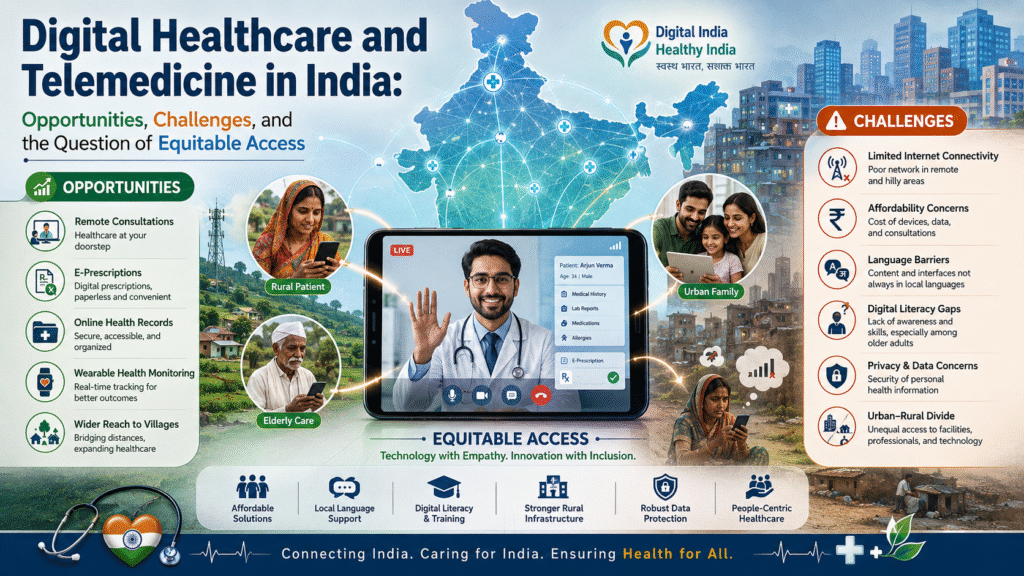
Digital healthcare and telemedicine have redefined healthcare accessibility in India, especially after the COVID-19 pandemic. During this period, telemedicine emerged as an important alternative to physical consultations and was further supported by government initiatives such as the Ayushman Bharat Digital Mission. These developments have often been presented as solutions to healthcare inaccessibility, especially in underserved regions. However, existing research suggests that unequal digital access, infrastructural limitations, and digital illiteracy continue to shape who can actually benefit from these healthcare systems.(Maroju et al., 2023) This article examines the opportunities and limitations of digital healthcare in India, with a particular focus on the question of equitable access.
According to WHO “ The delivery of health care services, where distance is a critical factor, by all health care professionals using information and communication technologies for the exchange of valid informationfor diagnosis, treatment and prevention of disease and injuries, research and evaluation, and for the continuing education of health care providers, all in the interests of advancing the health of individuals and their communities” is referred to as telemedicine. (World Health Organization, as cited in Maroju et al., 2023).
In India, telemedicine has increasingly been promoted as a solution to gaps in healthcare accessibility, particularly in regions where healthcare infrastructure and specialist services remain limited. Studies have shown that telemedicine can help address challenges related to distance, shortage of healthcare professionals, and the cost of in-person consultations. The COVID-19 pandemic further accelerated the adoption of telemedicine by highlighting the need for alternative modes of healthcare delivery and continuity of care. (Maroju et al., 2023).
One of the major opportunities created by telemedicine is its ability to extend healthcare services to remote and underserved populations. By enabling consultation through digital platforms, telemedicine reduces the need for travel and can improve access to preventive, diagnostic, and follow-up care. Government initiatives such as eSanjeevani and the Ayushman Bharat Digital Mission have also contributed to the expansion of digital healthcare infrastructure in India (Maroju et al., 2023) . These initiatives reflect a broader effort to use technology to address healthcare disparities and improve service delivery.
The rapid growth of telemedicine in India is reflected in the expansion of the eSanjeevani platform. According to a national analysis of eSanjeevani, more than 163 million teleconsultations were conducted between January 2020 and September 2023 across all 28 states and 8 Union Territories. The provider-assisted eSanjeevani Ayushman Bharat Health and Wellness Centre (AB-HWC) model accounted for over 93% of total consultations, highlighting its central role in India’s public telemedicine system (Sood et al., 2025).
Table 1. Key Data Points on Telemedicine Adoption and Digital Access in India
| Indicator | Data | Source |
| Total eSanjeevani teleconsultations (Jan 2020-Sep 2023) | More than 163 million | Sood et al., 2025 |
| Share of consultations through AB-HWC model | Over 93% | Sood et al., 2025 |
| State with highest teleconsultations | Andhra Pradesh (43.5 million) | Sood et al., 2025 |
| Second highest teleconsultations | West Bengal (22.9 million) | Sood et al., 2025 |
| Third highest teleconsultations | Tamil Nadu (21.5 million) | Sood et al., 2025 |
| Fourth highest teleconsultations | Karnataka (14.8 million) | Sood et al., 2025 |
| Fifth highest teleconsultations | Uttar Pradesh (12.3 million) | Sood et al., 2025 |
| Total internet subscribers in India (March 2024) | 954.4 million | tele.net, 2024 |
| Rural internet subscribers (March 2024 | 398.35 million | tele.net, 2024 |
| Villages with 3G/4G connectivity | 95.15% | tele.net, 2024 |
| Active internet users in India (2024) | 886 million | BestMediaInfo, 2025 |
Source: Compiled from Sood et al. (2025), tele.net (2024), and BestMediaInfo (2025).
While telemedicine has expanded healthcare accessibility, an important question remains regarding who benefits most from these services. Digital healthcare initiatives in India are largely intended to improve healthcare access for underserved populations, including rural communities, people living in remote areas, and those facing shortages of healthcare professionals. The eSanjeevani platform, for example, was designed to strengthen primary healthcare delivery and improve access to healthcare services through digital technologies. (Maroju et al., 2023).
However, evidence suggests that the actual users of telemedicine services are concentrated within certain demographic groups. A national study of eSanjeevani found that women constituted the majority of telemedicine users, while adults aged 25-45 years accounted for the largest share of consultations (Sood et al., 2025). The study also observed that telemedicine utilization was concentrated in a limited number of states, indicating variations in adoption across different regions of the country (Sood et al., 2025). These findings suggest that although telemedicine has increased healthcare reach, patterns of usage are not uniform across all population groups.
The question of equitable access is closely linked to India’s digital divide. Although internet connectivity has expanded significantly across India, differences in digital engagement persist between urban and rural populations. Urban users continue to have greater access to digital services such as e-commerce, online education, and digital payments, while rural users are more likely to rely on shared devices and face barriers related to digital literacy and infrastructure. These disparities directly affect the ability of different populations to access and benefit from telemedicine services .
Several barriers continue to limit equitable access to digital healthcare in India. Research has shown that effective use of telemedicine depends on access to smartphones, internet connectivity, electricity, and digital literacy (Maroju et al., 2023). Rural populations and economically disadvantaged communities often face challenges in accessing these resources. The eSanjeevani study further notes that teleconsultation uptake is influenced by digital infrastructure, smartphone ownership, and internet access, while digital literacy remains uneven across the country (Sood et al., 2025) Researchers also argue that inadequate healthcare infrastructure, technological limitations, and unequal access to digital resources continue to affect the reach of telemedicine services.
Therefore, although telemedicine has demonstrated significant potential to improve healthcare accessibility in India by reducing geographical barriers and increasing access to healthcare consultations, its benefits are not distributed equally across all sections of society. Addressing digital inequalities through improved internet connectivity, stronger digital infrastructure, and greater digital literacy will be essential for ensuring that telemedicine contributes to more equitable healthcare access in the future. Although telemedicine has reached more than 163 million consultations nationwide, regional disparities in utilization and persistent urban-rural differences in digital access suggest that equitable healthcare outcomes cannot be achieved through technological expansion alone (Sood et al., 2025).